 |
The Second Generation
Written by Kenneth Johnson
(The page numbers come from the 1st printing, trade paperback edition,
published February 2008) |
About 25 years after the Visitors' arrival,
the dying Earth and its population make a last bid for freedom
from tyranny when the alien Leader is received for the beginning
of the end of Earth.
Story Summary
Set 20 years after the original miniseries, The Second
Generation depicts an Earth still under Visitor domination
with the Resistance fighting a losing battle. They desperately
try to persuade the masses that the Visitors are evil aliens
bent on mankind's destruction. However, they are largely
ignored, as the many technological and social advancements
brought by the Visitors to the planet have convinced the
majority that the aliens have their best interests in mind. They
are halfway to taking all of the planet's water, under the guise
of cleansing it of all polluting substances. Many people were
also convinced to join the Visitors' civilian militia, the
Teammates (an evolution of the miniseries' Visitor Youth),
for the purposes of hunting resistance members.
Just when all seems hopeless, the message that Resistance
leader Juliet Parrish sent into space at the end of the original
miniseries is finally heard. An alien race called the Zedti,
who are long-standing enemies of the Visitors, reinforces the
Resistance in their time of need and soon the war is turned in
their favor. However, all is not as it seems, as the Zedti's
actions make the Resistance wonder about their newfound allies'
actual motives.
Notes from the V chronology
Johnson has chosen to ignore the events
of both
V:
The Final Battle and
V:
The Series (and the
accompanying licensed tie-ins) since he was not directly
involved with either incarnation and those continuations of the
story did not adhere to the style and sensibility he wanted for
V.
I have chosen to include it within my V80 chronology rather than as
a sidebar to it; since the novel takes place about 20 years
after these other stories, with some relatively minor mental
gymnastics the reader can pretend the events do follow all that
we have viewed and read before. After all, a lot could have
happened in those lost 20 years to account for many of the
seeming discrepancies. I'll make note of the discrepancies and
how they might be excused as they appear in the study below.
Didja Know?
The novel's author, Kenneth Johnson, is the creator of
V.
Johnson has chosen to ignore both V:
The Final Battle and V:
The Series since he was not directly involved with either
incarnation and those continuations of the story did not adhere
to the style and sensibility he wanted for
V. The story presented
was originally intended by Johnson as a follow-up mini-series in
2004, but Warner Brothers and television network NBC decided
they wanted a remake of the series instead (which eventually
became the reimagined
V series broadcast
for two seasons on ABC). Johnson chose to pursue getting his
story made as a theatrical film and novel. The Second
Generation is the first half of what he hopes will be a two
film cycle.
For some reason, the Visitor Flagship is over San Francisco
instead of Los Angeles and many of the principle resistance
characters seem to have moved to San Fran as well! In fact, L.A.
is not even mentioned in the book. Additionally, Robin Maxwell
and her alien pregnancy are never mentioned, despite the
existence of other half-breed children, nor is the concept of
the Visitors' conversion process. The novel seems to be a sequel
to a somewhat reimagined version of the first mini-series rather
than a direct sequel to the original.
Didja Notice?
The dedication of the book is the same as the one that appeared
at the beginning of the original mini-series: "To the heroism of
the resistance fighters – past, present and future – this work
is respectfully dedicated."
Johnson's description of the constellation Orion in the night
sky and its location in relation to the Visitor's star, Sirius,
on page 10, is accurate.
Also on page 10, Meyer thinks ironically that the Visitors have
been "visiting" for a very long time now, over twenty years.
Page 14 mentions
Hooters. This is a real world restaurant chain
which features attractive waitresses in tight t-shirts.
Page 18 mentions that the Zedti commander Ayden has several
scars on the pseudo-skin of his fake human body, including on
his face. Since the skin is false, why bother to perpetuate the
damage on it? He could easily have a perfect-looking human body.
Perhaps (as I speculated on the Visitor Klaus in
"The Sanction"),
it is meant to reflect a real scar on his
alien face that he feels is a badge of honor.
On page 20, Johnson tricks the reader with the first two
paragraphs of Chapter 2 into thinking he is describing one
of the reptilian Visitors, when it turns out it is actually an
iguana sunning itself on a rock in the desert.
Page 21 reveals that about a decade ago (around 1997), Diana had
the uniforms of most of the Visitor personnel changed to not
look so militaristic and are now an ensemble of dark pants and
ivory shirt with subtle rank stripes. Only the actual troopers
have maintained the original red (described here as orange)
jumpsuits and black jackboots.
Also on page 21, Diana is described as a Commandant, maintaining
the more Nazi-esque militarism depicted in Johnson's original
V mini-series.
Page 22 suggests that the Leader came into power after years of
war and corrupt government, eventually restructuring their
society into a rigidly structured and militaristic one. His
opponents began to disappear or meet with unfortunate accidents
or assassinations and he determined to conquer other worlds and
absorb them.
Page 22 also reveals that the Leader has not yet visited Earth.
(In "The Return", the Leader
allegedly comes to Earth to meet Elizabeth, but the unproduced
script for the season premiere of what would have been season
two of the series does suggest that he was actually in another
dimension and would have brought her into that dimension for
their parlay).
Page 23 mentions that what has been called the Great Purge took place in 1999. The
Purge resulted in the betrayal and murder of huge numbers of
human resistance and Visitor fifth column members, leaving the
opposition to the Visitors virtually shattered.
Page 56 reveals that this was 8 years ago, setting the novel in
2007.
Page 23 also reveals that the Visitor Youth organization is now known as the
Teammates. Their uniforms have also changed, to dark blue cords
and blue chambray shirt, as described on page 25.
Page 24 reveals that there is a mothership over
Honolulu, HI.
The story of the English Captain James Cook and his deification
and eventual death in Hawaii as told on pages 24-25 is true.
Page 26 reveals that much of the Pacific Ocean has become desert
due to the Visitors' theft of the Earth's water.
Page 27 mentions that the panels on the exterior of the
mothership's hull resembled scales. This is similar to the
depiction of the motherships in
V2000. Here, the
San
Francisco mothership is said to be the Flagship of the Visitor
Armada. Page 105 describes the Flagship as being 16 miles wide!
Previous V stories
suggested the motherships were 3-5 miles in diameter.
Also on page 27, Nathan and Sarah are attacked by Class Four
fighters, which are larger, faster and more maneuverable than the
Class Two fighter they are flying. The fighter class seen in the
V TV series is unknown;
presumably they were either Class One or Two.
Page 28 mentions that the Sacramento and San Joaquin rivers near
San Francisco are much diminished due to the Visitors' theft of
Earth's water.
Page 28 also describes what seem to be holographic control
panels used in the Class Four fighters and page 131 suggests
similar displays in the Centcom of the Flagship (another similarity with
V2000).
Page 30 reveals that Ysabel used to work for
Microsoft, which
is, of course, a real world software company.
Most of the novel takes place in San Francisco and most of the
street and building names used are real world locations in the
city or its environs:
the Goldern Gate Bridge;
page 31 mentions Montgomery Street and the
Transamerica
building; on page 57, Ruby and Nathan head down Clay Street in
Chinatown; Emma lives in a posh condo on Nob Hill; the character Street-C can
be found at times at Cordelia and Broadway in the Tenderloin
District, though there is not a brownstone there that quite
matches the description in the novel; the intersection of
Fremont and Mission streets (though there does not appear to be
a newsstand there as described); on page 66, Bryke turns east
off of Guerrero Street onto 22nd, heading toward the Mission
District; Potrero Avenue and 18th Street; the James Lick
Freeway; Franklin Square Park and Hampshire Street (where
Harmony makes a drop-off to a resistance courier); Franklin
Street; Bryant
Street; the University of California San Francisco Medical
Center at the southeast corner of
Golden Gate Park; Hemlock
Street; Van Ness Avenue; the
Mark Hopkins Hotel; Lafayette Park;
Washington Street; Hunter's Point; the Bay Bridge; Yerba Buena
Island and Treasure Island Naval Reservation; Stanyan Street;
Hayes Street; Presidio Heights;
California Academy of Sciences;
Baker Street; the
Palace of Fine Arts; the
Ferry Building at the
Embarcadero; Berry Street; Interstate 280; China Basin;
Bethlehem Shipyards (though in our world, the shipyard was sold
in the mid-90s and is now known as BAE Systems San Francisco Ship
Repair); Islas Creek at Cargo Way;
San Francisco International
Airport; Fulton Street;
Davis Symphony Hall;
the city of Oakland; Marin County (north of San Francisco);
San
Francisco Symphony Orchestra and Chorus; Pine Mountain (in Marin
County); the city of
Alameda; the
Presidio;
Fort Point;
and the city
of Sausalito.
Page 32 mentions a trolley car on the streets of San Francisco.
The city is well-known for maintaining its use of the electrical
trolley car system for public transportation (though reduced
from its heyday in the late 19th and early 20th centuries).
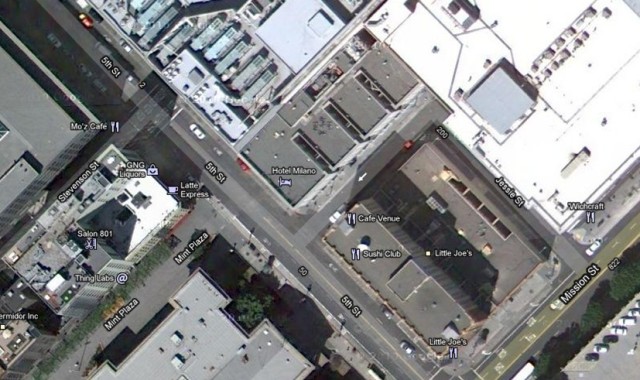
Nathan and Sarah's skyfighter crashes at the intersection of
Market St. and 5th St. Nathan runs with the wounded Sarah in his
arms south down 5th, towards Stevenson St. These are all actual
streets and intersections in San Francisco. After Sarah dies in
his arms, Nathan runs off and is beckoned by little Ruby down
Jessie Street, which turns out to be a dead end; Jessie Street
is also a real road in San Francisco, though it's not quite a
dead end as described here; however, in the
V universe it might
well be.
Page 33 mentions that the Visitors are announcing a medical
breakthrough that will eliminate all strains of the deadly Ebola
virus, a real world virus first witnessed in 1976.
Pages 35-36 mention the Airborne Visitor Patrollers, who use
propulsion packs strapped to their backs to fly through the air.
This is similar to the Visitor troopers who chase Tyler and
Chris in
"City on the Edge".
Page 36 reveals that there are a number of human-Visitor
half-breeds now living as second-class citizens on Earth. We
don't get an explanation of how human and Visitor DNA could be
similar enough to produce offspring through standard sexual
reproduction. The novelization of the original mini-series
implies that Diana had to make augmentations to Robin and Brian
in order for her reproduction experiment to work. And, speaking
of Robin, what happened to her and her half-Visitor pregnancy in
this incarnation of the saga? Since Johnson ignores the events
of V: The Final Battle,
what was the outcome of Robin's pregnancy?
Page 36 describes little Ruby as having "an Artful Dodger
twinkle in her blue eyes". Artful Dodger is a reference to the
nickname of the character Jack Dawkins in Charles Dickens'
classic 1838 novel, Oliver Twist. The term Artful
Dodger has come to mean someone who is able to dodge
responsibility or the consequences of their own actions.
Students Danny Stein and Thomas Murakami are described as
attending Patrick Henry Middle School on Ortega Street at 41st.
In the real world, Sunset Elementary School exists at that
location in San Francisco. Patrick Henry (1736-1799) is known
for his "Give me liberty, or give me death" speech in 1775,
helping to spur the American Revolution against Britain.
Page 38 implies that public schools around the world must play a
frequently-updated propaganda video called The Visitor Way.
Over the course of several pages of the novel, the video reveals
several interesting items of note: there is a mothership over
Beijing, China and seems to imply it has been there from the
start, when the Visitors arrived in
"Arrival"; one of their own, named Paul, is the Visitor
Press Secretary (human reporter Kristine Walsh filled this role for
them in the two original mini-series until her betrayal of them
and subsequent death at Diana's hand in
"Unmasked"); besides presenting a more pleasing form to the
humans of Earth, the Visitors' pseudo-skin coverings also
protect them from the ultraviolet radiation of Earth's sun
(this is supported by
The New England
Resistance which describes the Visitors' homeworld as
having a thicker layer of carbon dioxide in the atmosphere,
making the light of the sun dimmer);
human scientists, still treated with disgrace due to the
Visitors' ongoing propaganda, are often referred to simply as
Scis; the Visitors claim that Earth will also be a base of space
exploration for them (as it turns out in the novel, it will
actually be a base used as a stepping stone to launching an all-out
attack on the insectoid Zedti).
On page 38, Johnson makes sort of a play on words in the
sentence, "Danny nodded to doubting Thomas." A "Doubting Thomas"
is a person who refuses to believe in anything of which they do
not have direct physical evidence. The term originates from the
portion of the Bible in which Thomas the Apostle doubts
the resurrection of Jesus.
Also on page 39, Emma is described as wearing a Hamlet-style
blouse, but I'm not really sure what that is!
Page 42 reveals that
in Johnson's vision of how V
would have proceeded, Dr. Robert Maxwell still lives (in the weekly TV series
episode "Dreadnought", Maxwell
sacrifices his life driving the captured L.A. mothership into
the Visitors' orbital Dreadnought weapon). Also revealed is that
Robert is a Nobel Prize winner in his field of
anthropology.
Page 42 also reveals that all Scis have been implanted with ID
chips.
Page 43 reveals that Scis are forced to live in separate
communities from other humans. The
The Visitor Way depicts these communities as
being pleasant, park-like suburbs, but the reader quickly learns they are
more like ghettos.
Page 43 introduces the character of Connie Leonetti. Is she
meant to be related to Donovan's former sound man, Tony Leonetti,
who was killed in "Betrayal
and Reward"? We're not told if there is a connection.
Page 44 introduces us to San Francisco's mayor, Mark Ohanian. In
the real world of 2007, the mayor was Gavin Newsom.
Page 44 reveals that the Visitors have given Earth a cure for
Alzheimer's disease, which is a fairly common form of dementia
suffered mostly by the elderly. Other "gifts" from the Visitors
are the virtual end of global terrorism, the near end of crime,
cheap fuel cells that eliminated humanity's dependence on oil,
an end to famine, and cures for AIDS, heart disease, and most
forms of cancer.
When Elgin and Blue realize the Visitors are cooking up vats of
some kind of insecticide at the chemical plant, Blue wonders if
they've got some kind of giant cockroaches somewhere they
want to exterminate. That turns
out to be a pretty good guess when we learn who the Leader's
main enemies in the galaxy are!
Page 46 reveals that there is a Visitor greeting-salute, the
right hand extended and slightly raised, palm up. In
"The Betrayal"
and "The Littlest Dragon",
Willie and other Visitors demonstrate a greeting with a hand
raised to about face-level and grasp the hand of the other.
Page 47 reveals that the current U.N. Secretary-General is
Alberto Mendez. In the real world it was Ban Ki-moon.
Page 48 suggests that many people feel that most world cities
have become like occupied-Paris during WWII.
Page 49 introduces Ruby, the young half-breed. Presumably, she
is named after resistance member Ruby Engles, who died in
"The Masterpiece".
Page 50 explains that the Visitors have explained that they are
taking Earth's water to purge it of pollutants and toxins, but
they can't return it until most of it is gone so it doesn't just
get re-contaminated by the foul water. (Those sneaky devils!)
Also on page 50, the resistance video says that the Visitors
taking Earth's water is like how Mulholland dried out the Owens
Valley to nourish Los Angeles. This is a reference to the
California Water Wars of the early 20th century, which left the
Owens River and the formerly good farm land of the Owens Valley
as a dry, alkali flat.
The resistance video also explains that besides sustaining life,
water also powers the Visitors' ships and weapons.
Page 59 reveals that the Pacific Basin is dried up almost
halfway to Hawaii from the west coast of California (page 92
reveals the basin is now known as the Pacific Desert). This has caused the
climate in San Francisco to become more severe, with colder
winters and even some snow in recent years.
Page 62 mentions that Mary Elgin attended Fine Arts classes at
Carnegie-Mellon. This is a real university in Pittsburgh,
Pennsylvania and is also the alma mater of Kenneth Johnson
himself, who attended the Institute of Technology there.
Page 64 mentions that Street-C is quite literate despite his
street-wise ways, having read many books banned by the Visitors.
One of them is Will Durant's The Story of Philosophy.
This is a real book, first published in 1926, about the great
philosophers of history.
Page 68 reintroduces us to Harmony who, in this incarnation of
V, has survived these
past 20 years (she was killed by a Visitor laser gun blast in
"The Final Battle" in the
original chronology). Here, she has a teenage half-breed son
named Ted with Willie (though only the three of them know that
Willie is his father since Willie is still officially a loyal
member of the Visitor occupation, while secretly a member of the
fifth column). Page 222 reveals that Willie and Harmy are
married, but that is presumably a secret to all but their
closest allies.
On page 72, Harmony gives Ted a copy of Charles Dickens'
Great Expectations. The novel was originally published as a
serial in the periodical All the Year Round from December
1860-August 1861.
Page 73 reveals that despite the passage of 20 years of time,
Willie still has a habit of speaking in malapropisms.
Page 77 reveals that San Francisco's Sci Section is in the
Mission District.
Page 77 also reveals that the water loss on the planet has sped
up global warming and left the Amazon Basin a dustbowl.
Johnson capitalizes the "D" in Dumpster throughout the book
because it is actually a brand name of the large, steel outdoor
trash receptacles which have taken on the genericized term of
"dumpster".
Page 79 states that the Stein family lives in a small house on
Moraga Street near 31st Avenue, 5 blocks south of Golden Gate
Park. This is an actual residential neighborhood. Their house is
described as being decorated in
Sears/Wal-Mart Traditional, a
reference to the two major department store chains known for
their inexpensive, but functional, house wares.
On page 90 a cop accuses a local vagrant of sucking down cases
of Ripple. Ripple was a cheap carbonated wine made by E&J Gallo
Winery from 1960-1984, so it's a bit odd that a cop would still
be saying this in 2007. But, since 1984 is shortly after the
Visitors' arrival on Earth, maybe more people were still
drinking the cheap stuff and that kept the production going in the
V universe!
Page 93 suggests that human collaborators with the Visitors are
commonly known as Players.
Page 94 shows that Willie and Martin have become friends through
their association with the fifth column. Of course, in the
original TV series timeline, Martin died in
"Liberation Day".
Page 96 reveals that Diana had carefully calculated her face and
figure to appeal to both male and female humans.
On page 96, the shuttle of the Leader's Emissary, Jeremy, is
silver-sheened instead of white. When the Leader later arrives,
it is in a golden-hued craft.
Throughout the novel, it is suggested that Jeremy has been
engaged in an affair with the Leader.
Patrick Henry Middle School's Vice-Principal Gabriel is
presented with a diamond signet ring by the Visitors in
appreciation for his help. Daniel Bernstein received a similar
gift for his services in
"Betrayal and Reward".
The Visitors hint that Vice-Principle Gabriel will receive a transfer
and promotion to Principal at Benjamin Franklin. This is
probably a reference to Benjamin Franklin Middle School, which
actually exists at Scott St. and Geary Blvd. in San Fran.
Page 102 mentions Parnassas Precinct. This is probably a
reference to the police precinct around Parnassus Avenue in San
Francisco, near Golden Gate Park. (Johnson also used the name
Parnassus for the company Parnassus Imports in the Stop
Susan Williams segments of his 1979 TV series,
Cliffhangers!)
Level 125 of the Flagship is described as reserved for the
highest strata of the Visitor command and their guests and
referred to by pundits as a combination Visitor White House,
Pentagon, Kremlin, and Mount Olympus. The
White House, of
course, is the official home of the U.S. President; the
Pentagon
is the headquarters of the U.S. Department of Defense; the
Kremlin is the official home of the Russian President; Mount
Olympus is the highest mountain in Greece and was the
mythological home of the gods.
On page 105, Jeremy tells Diana that he was sorry to hear of the
original Commandant's "accident". Presumably, this is a
reference to Diana's secret assassination of Supreme Commander
John at some point. (In the original chronology, Diana shot John
in cold blood as the resistance was gaining the upper hand
against the Visitors due to the release of the red dust in
"The Final Battle".)
On page 107, Diana offers Jeremy some fresh food in the form of
"chunks and shreds of flesh...twining entrails...small organs
and glandular meats...all raw and coated in a thin film of red
blood." Yum!
On page 113, the snaking cables of the suspension pods holding
the frozen humans on the Flagship remind Jon of the mythological
Medusa. In Greek mythology, Medusa was a Gorgon, a hideous woman
with snakes for hair whose gaze would turn anyone who looked
upon her face into stone.
Page 113 also reveals that Jon has read many banned Earth books
such as Brave New World, 1984, All the
President's Men, and
Huckleberry Finn. These are all real books, of
course. The first three are probably banned by the Visitors due
to their depiction of government and its officials acting
deceitfully,
Huckleberry Finn probably for the title
character's flaunting of authority.
Page 116 mentions The Truth, which turns out to be a
series of underground videos released by the resistance to
spread the word that the Visitors have been lying to the people
of Earth during their entire 20-year "visit" to our planet.
The Truth seems to be sort of the resistance's
counterpart to
The Visitor Way.
Page 116 also mentions that CNN and Voice of America don't exist
anymore. CNN, of course, is the Cable News Network which, in our
world, has been broadcasting since 1980 and still going strong.
Voice of America is the official broadcasting institution of the
U.S. government, propounding its positions, and delivering news and entertainment (some would
say propaganda) to other countries around the world, via radio,
television, and internet in over 40 languages.
The resistance newsstand owner, Ahmed, is described as having
fled a Visitor dragnet in Riyadh.
Riyadh is the capital city of
Saudi Arabia.
Page 122 reveals that Julie is 5'2" in height, 46 years old,
born in Michigan, raised on a farm, and was a Republican when
the nation still had a human-led government. Page 123 states
that Julie still walks with a limp after all these years, from
the injury she received from a Visitor pulse gun way back in
"Visitors, Victims and Victory".
Page 133 reveals that Julie speaks fluent French.
"Tennyson" says that her home town
was Echo Valley, New Mexico, but that does
not entirely conflict with the novel's statement since her Echo
Valley house does have a barn on the property, implying it was
once a farm. She may have been born in Michigan and her family
later moved to New Mexico.
Page 123 tells us that Julie had been engaged to Denny, her
stockbroker boyfriend last seen in "Visitors,
Victims and Victory". Here it is also revealed that Denny
later spoke vehemently against her and the resistance.
Also on page 123, Margarita is holding a Kalashnikov. The
Kalashnikov is a popular line of Russian automatic rifle, the
most commonly known of which is the AK-47, designed by Mikhail Kalashnikov.
On page 128, Julie refers to The Big Lie. Obviously she
is referring to the Visitors' propaganda that states they are
our friends and here to help us. The term The Big Lie is also
used to describe propaganda techniques in general that use
outrageous untruths in the belief that populations will actually
fall for a big lie more easily than a small one; the term was
first coined by Adolph Hitler in his 1925 book Mein Kampf.
On page 129, Bryke shoots a blob of gelatinous substance onto
the side of Margarita's car and a swarm of insects begins to
buzz around it. This is an early indication of the new aliens'
insectoid ancestry.
Also on page 129, Kayta stares at a crow, which then gets
uncomfortable with the attention and takes flight, causing her
to smile ironically. The irony is that crows prey upon insects,
yet here Kayta could be conceived as an insectoid predator who
could be hunting the crow.
Page 130 reveals there are now 250 motherships over Earth.
Page 130 also reveals the Centcom on the Flagship, the center of
the fleet's operations, is nearly the size of a football field,
with four levels.
On page 133, Jeremy asks Diana if the hairy prisoner she's
keeping is Bigfoot. Bigfoot is an alleged ape-like creature
living in the Pacific Northwest of the United States.
Page 135 reminds the reader of the signal the resistance sent
out into space, asking for help from enemies of the Visitors, at
the end of "Plan for
Resistance". On page 187, the Zedti confirm they received
this message.
Page 136 reveals there was an uprising against the Visitors in
London in 1991. It was believed that Mike Donovan died there.
Page 139 mentions George Washington, Thomas Paine, and Common
Sense. Washington, of course, is considered the father of
the United States, having served as the country's military and
political leader from 1775 to his death in 1799. Thomas Paine
was another of the founding fathers of the country and published
the pamphlet Common Sense, advocating the American
colonies' independence from Britain.
The description of Themistocles and the Battle of Marathon on
page 140 is accurate.
Also on page 140, Nathan quotes Santayana, referring to George
Santayana, a Spanish-American philosopher who lived from
1863-1952.
Nathan reminisces on a moment from his past on the Big Island.
This is a reference to the largest island in his home state of
Hawaii, itself also called Hawaii, or the Big Island to prevent
confusion.
Page 141 mentions that a Cyclone fence encircles the chemical
factory where the Visitors are producing their insecticide. This
is another name for a chain-link fence, a type woven from steel
wire. For some reason, Johnson consistently capitalizes the C
when mentioning the cyclone fence throughout the novel, but I am
not aware of it being a brand name as well. It's possible
Johnson was making a connection with Zyclon B, the brand name of
a pesticide that was also used by Nazi Germany to execute
prisoners in extermination camps in their gas chambers; "Zyclon"
is German for "Cyclone".
A Teammate Humvee is mentioned on page 144. The word stands for
High Mobility Multipurpose Wheeled Vehicle, manufactured by
AM
General mostly for the U.S. military. The vehicle has replaced
the former high-mobility vehicle, the Jeep, in the U.S.
military.
On page 146, Jon comments on his own tinkering together of
devices as a bit of Swiss Family Robinson Crusoe. He is
humorously melding the titles of Swiss Family Robinson
(1812) and Robinson Crusoe (1719), both of which are
novels about people shipwrecked on an island and forced to
survive, often building living structures and other devices from
the material available around them to make life there
easier. Jon also compares the life of a dreg to The
Invisible Man, an 1897 novel by H.G. Wells about a man who
could turn himself invisible.
Also on page 146, Jon receives some new data plugs from Willie,
one of which is titled Tenctonese biogeometrics. The
Tenctonese are the aliens in the Alien Nation franchise
(the TV series was produced by Johnson)!
Biogeometrics is the study of the human body's response to
outside physical forces, such as used in chiropractics. On page
286, Willie gives Jon a data plug of the Nasus Ganilppa
Periodic Tables; ganilppa is a word in the Tenctonese
language, though I don't know what it means; perhaps "nasus" is
also a Tenctonese word, but I have been unable to find reference
to it.
Page 148 describes Emma as driving a Lexus.
Lexus is the luxury vehicle division of Toyota.
Gary's apartment is described as being at 5th and Howard on page
152, but in the real world there is no apartment building at
that intersection. The narrative also mentions that Gary's
apartment window looks eastward across the
Moscone Convention
Center. The convention center is actually located two blocks
east, on 3rd Street.
Page 155 tells us that the current San Francisco resistance base
is called Lexington Base. Possibly this is a reference to
Lexington Street, though it seems unwise to refer to the base
that way over a telephone as Julie does here.
Page 162 reveals that the Visitors had Donovan addicted to
morphalyne while he was their prisoner. This must be a
Visitor-created drug that was given to humanity as a "gift"
because there is no such drug on the market in the real world.
Also on page 162, Willie reveals that the Visitors are working
on a voice modifier to make their voices sound more like humans.
In Prisoners and Pawns,
the Visitors already have the capability to surgically implant
an electronic filter that can make a Visitor voice sound human.
On page 171, Emma takes Charlotte to an unnamed hospital on Hyde
Street. This must be
St. Francis Memorial Hospital, which is on
Hyde in San Francisco.
Page 174 mentions San Mateo County being just south of San
Francisco. This is accurate.
The doctor at the hospice on Treasure Island tries to find some
diatome to give to the dying Charlotte. Diatome must be another
Visitor-derived drug.
On page 182, Emma feels like she's been Scarlett O'Hara, living
a privileged and self-absorbed life until discovering the
horrors of war that common people have had to contend with.
Scarlett O'Hara is the protagonist of the 1936 novel Gone
With the Wind by Margaret Mitchell.
On page 184, Blue ponders on the torments suffered by Jesus at
Golgotha. Golgotha is the site in ancient Jerusalem where the
crucifixion of Jesus took place.
On page 191, the Zedti claim to be from the star Altair, about
16 light-years away from Earth. This is correct, though we later
learn that the Zedti are lying when they say that is where they are
from.
On page 193, Emma muses on her new career as a Mata Hari. The
term Mata Hari has come to stand for a woman who uses sex to win
the confidence of men from whom she gleans vital information for
a third party. It comes from the stage name of Margaretha Zelle
MacLeod, a renowned Dutch exotic dancer in the early 20th
Century who was also a spy for French Intelligence and later
accused of being a double agent actually working for wartime
Germany of WWI. She was tried and found guilty of this under
questionable evidence and executed by firing squad in 1917.
Pages 193-195 describe the significant enlargement of Earth's
landmasses due to the theft of water from the world's oceans by
the Visitors.
Jeremy tells Diana that his new module attachments to the
motherships will allow the water collection on Earth to be
completed in mere weeks instead of the years it would take under
Diana's current plan.
During Julie's remembrance on page 200, the old Ruby's last name
is given as Brown, but in the V
novelization it is stated to be Engels. As her remembrance
concludes on page 201, it states that Ruby was killed a few
years after the Visitors' arrival by a young Teammate; in the
original mini-series, it was mere months after the arrival that
she was killed by Visitor Youth member Daniel Bernstein.
On page 201, Margarita tells the Zedti that they coordinate 207
resistance cells worldwide.
Julie mentions, on page 202, that Robert Maxwell is leading a
team trying to create a biological agent they can use against
the Visitors. This sounds similar to the red dust that first
appeared in the
V:
The Final Battle mini-series, which Johnson has
dismissed from his continuity.
On page 202, Margarita refers to the Visitors as a hyper-power.
This is a term sometimes used to describe a super-power state
which has no real rivals to challenge its superiority.
Also on page 202, Ysabel implies that Niagara Falls has dried up
due to the Visitors' water theft.
Page 206 mentions the Euclid Fire Station, housing Engine Company
34 on Presidio Avenue. In the real world, Engine Company 34 of
the SFFD is located on 41st Avenue, some distance away. There is
a Fire Department Museum on the corner of Presidio and Euclid
Avenues which was probably Johnson's inspiration for this
location.
On page 207, Margarita jiggles into the Euclid Fire Station
"smiling like Little Mary Sunshine" at the men. This is a
reference to a character in the play of the same name which
originally premiered off Broadway in 1959. The character is a
caricature of alluring operetta heroines.
Also on page 207, Margarita tells the firemen she lives "over on
Lake." Lake Street is, indeed, close to Presidio and Euclid
Avenues in San Fran.
The motorcycles used by the Zedti in their scouting on Earth are
very similar to the turbocycles used by Colonial Warriors Dillon
and Troy in the TV Series
Galactica 1980! In both
cases, the alien cycles are quiet, fast, and capable of flight
and invisibility.
On page 212, Willie and Harmony have slipped into an old movie
theater showing vintage films to rest after Harmy's ordeal at the
police station. The film playing isn't named but from the
description it is recognizable as Casablanca (1942).
Page 218 mentions that Diana's quarters have a view of San Mateo
in the distance. San Mateo is one of the larger suburbs of San
Francisco.
On page 221, Emma has learned that the prime reason the Visitors
came to Earth was to set up an advance base for launching
attacks against the Zedti.
Page 221 reveals that Ayden is the leader of all the Zedti.
Margarita mentions on page 222 that Winston Churchill once said
that the only thing worse than having allies is not having
allies. This is a true quote of his.
The Visitors have their huge reception for the Leader at
Candlestick Park. This was a major outdoor sports stadium and
entertainment arena in San Francisco, formerly the home of MLB's
San Francisco Giants and the NFL's SF
49ers. It was demolished in 2015 to make way for new housing
tracts, though as of 2018 the housing tract plan had been
withdrawn.
Pages 228-229 describe the Zedti Flagship, which appears to be
organically grown and is twice the size of a Visitor mothership.
The enormous ship is described with references to Jonathan
Swift's 1726 novel Gulliver's Travels (which has not been out of
print since!). The verb Brobdingnagian used here originates in
Gulliver's Travels and refers to the land of Brobdingnag, where
everything is gigantic compared to our proportions (people there
are around 70 feet tall).
Page 229 indicates that the Zedti are not wearing false skin to
impersonate humans, they look enough like us to pass (though
with some odd features such as a sheen to their skin and
unusually colored eyes such as pink or violet). We are not given
a clear explanation of how a species descended from insect-like
creatures has evolved to look mostly human.
Page 229 also states the Zedti language has a hissing, clicking
quality.
Page 230 reveals that Street-C drives a rattletrap Toyota.
Toyota
is a Japanese automaker.
On page 237, Emma tells Mark to meet her at Gilman Park on
Griffith, just north of Candlestick Park. This small park exists
in the real world, but is actually known as Gilman Playground.
On page 247, Bryke is engaged in what is described as a tai-chi
type exercise. Tai-chi is a Chinese martial art. Bryke is also
compared to a Zen dance-soldier; Zen is a form of Chinese
Buddhism which teaches that wisdom is reached through experiential
self-realization. The V
novels The Alien
Swordmaster and
Symphony of Terror describe the banned Visitor religion
of preta-na-ma as similar to Zen Buddhism.
Bryke's description of mayflies on page 248 does not appear to
be entirely accurate. She tells Donovan, "They are born, they
live, they mate, and they die in only eighteen hours." There are
many species of mayflies with varying lifespans; as adults they
live from 30 minutes to one day. In their immature form as
naiads, they are aquatic and live quite some time, usually about
a year.
The Zedti are actually made up of at least three different
insectoid species. In Ayden's species, the females excrete
gelatinous eggs which are carried by the male until birth.
Donovan compares this with seahorses, which is an accurate
representation.
On page 270, Kayta tells Donovan the Zedti homeworld is mostly
desert.
On page 278, Blue muses on one of his ancestors who was part of
Harriet Tubman's Underground Railroad. The Underground Railroad
was the clandestine network of contacts and safe houses in the
U.S. of the 19th Century that allowed black slaves to escape to
the free states or Canada.
Harriet Tubman, an escaped slave herself, made numerous trips
back to the southern states to aid many other slaves in escape
to freedom.
On page 282, Emma, fearful of being caught as a resistance
sympathizer, contemplates fleeing to one of her other homes
around the country: Central Park West (a high rent area in
Manhattan),
Portland, Oregon, and Lake Tahoe (a resort area in
the Sierra Nevada mountains along the border of California and
Nevada).
Page 293 describes the Secretary-General's wife being held
indefinitely by the Visitors at a brownstone on Jackson Street,
just north of Lafayette Square, next to the California
Historical Society Museum. In the real world, there is no
Lafayette Square in San Fran, though Jackson is one block north
of Lafayette Park. And the California
Historical Society Museum is located some distance away on
Mission, not Jackson.
On page 299, Nathan and Street-C wait to meet Emma at Civic
Center Park. Although there does not appear to be a place
officially called Civic Center Park, the descriptions of it in
the book as being on Grove and Larkin Streets indicate it as a
small park-like area that does actually exist in the region of Civic Center Plaza
in San Francisco.
The Secretary-General reveals that the human prisoners that are
podded aboard the motherships are fed information and
instruction in their deep sleep in order to prep them to become
good, obedient soldiers for the Leader.
Page 322 mentions that, until this moment, Julie had only ever
called Donovan "Mr. Donovan", not Mike, as a little joke that
had never changed between them. And he had never called her
Julie until page 324. (Obviously, this is another instance of
difference between this incarnation of
V and the original ongoing series.)
On page 324 Donovan tells Julie he thinks Altair is a green
star, not yellow as described by Kayta. However, from what I
have been able to find online, Altair is, indeed, a yellow star.
Donovan is correct in saying it is not a binary star system as
stated by Kayta.
Page 327 describes the torture chair that can be suspended
upside-down into which Bryke is strapped. It sounds similar to the
chair Lydia is strapped into for her execution in
"Blood on the Wind".
Page 338 says that three tenors from the Metropolitan Opera have
joined the ceremonies at Candlestick Park. The
Metropolitan Opera operates out of New York City and is one
of the premier opera associations in the world.
On page 339, the San Francisco Symphony Orchestra and Chorus
is playing Beethoven's Fifth Symphony.
A
slower tempo version of the first four staccato notes of
Beethoven's Fifth Symphony is what is used during the first
appearance of a mothership in the original mini-series ("Arrival").
Page 339 also mentions Elgar's "Pomp and Circumstance". These
are a series of military marches composed by Sir Edward Elgar in
England.
On page 340, Emma sings "The Battle Hymn of the Republic" with
new lyrics provided by the Visitors. The words of the original
hymn were written by Julia Ward Howe in 1862, using the music of
an 1862 song called "John Brown's Body", about the abolitionist.
Other resistance cells around the world know the San Francisco
resistance as the Prime Resistance Cell since Julie Parish is
basically considered the world leader of the resistance.
Page 343 reveals that the Leader is female. Although a nice
twist, this goes against statements in many previous
V stories,
including Johnson's original mini-series itself, which uses the
pronoun "he" when Visitors refer to the Leader. Possibly it
could be argued that the Leader at the time of the Visitors'
arrival on Earth was a male and a new one came into power during
the intervening 20 years.
Page 346 compares Diana's staging of the cameras for the
Leader's appearance at the ceremony as similar to that used by
such great film directors of the past as John Ford, Orson
Welles, and Leni Riefenstahl. These were all real film
directors, the first two Americans, and Riefenstahl a German who
actually made skilled, if historically distasteful, propaganda
films for Hitler and the Nazis.
Also on page 346, the Leader is described as having the skills
of a Great Communicator. This is, presumably, a reference to the
U.S. President Ronald Reagan, whose ability to speak to the
people in an easily friendly manner earned him the nickname The
Great Communicator. However, the novelization of the original
mini-series would seem to indicate that Reagan was never
President in the V
universe; instead it was William Morrow.
Kayta mentions on page 363 that the Zedti have thermobaric
nuclear weapons. The term "thermobaric" refers to bombs that
produce a blast wave that lasts significantly longer than those
of conventional explosives. On Earth, the term has not been
applied to nuclear weapons, but the Zedti apparently have
nuclear weapons which produce such a lasting blast wave, which
they hope will cause greater destruction to the Visitor
motherships (and, unfortunately for us, to Earth as well!).
On page 378, Diana comments that Jeremy is "quite on top of
everything." This is a double-entendre referring to his
efficient deployment of troops and weapons against the Zedti
and, between the lines, his sexual affair with Gina.
On page 379, Ruby tells Emma that the half-breed janitor Jon
could give Einstein a run for his money. Einstein, of course, is
a reference to Albert Einstein, the renowned German theoretical
physicist who refused to return to Germany from the U.S. after Hitler came
into power, and became an American citizen.
Page 379 also reveals that the Visitor Flagship uses a quantum
computer mainframe. Quantum computing is still in its infancy on
Earth, but is a legitimate field of study, using the laws of
quantum mechanics to perform computational operations on data.
Keeping a quantum computer at ultra low temperatures as stated
in the novel is also a real aspect of quantum computing due to
the need to keep the system as isolated as possible from the
external world to limit or prevent interaction and thus
decoherence of the system.
Page 381 makes reference to Rumpelstiltskin, the character from
the German fairy tale popularized by the Brothers Grimm in
Children's and Household Tales of 1812.
On page 384, Emma refers to her recording mixer Westie, as C.B.
Presumably, these are the initials of his real name, but we
never learn what it is. Clayton Barr, perhaps? ;)
On page 385, Margarita tells the fake Nathan about a resistance
meeting site at an old factory at the corner of Park and
Piedmont in Oakland. Later, on page 388, Ruby says the
intersection is just a bunch of sleazy used car lots. There does
not appear to be such an intersection in the Oakland of the real
world, though there are roads called Park and Piedmont there
which never intersect.
On page 387, Gary gives his Visitor life partner, Eric, one of
the yellow stickers to put on his uniform to protect him
(although he is not apparently a true fifth columnist) in the
coming assault against the motherships. Gary tells him only,
"Don't ask...Don't tell." Given the homosexual relationship
between the two, this comment is probably a joking reference to
the U.S. military's (now former) policy on homosexuals serving in the armed
forces popularly referred to as "Don't ask, don't tell." It's
unknown whether this policy actually exists in the
V universe since it was
enacted in the 1990s in the real world; Earth (and thus, the
U.S.) would have been subject mostly to Visitor rules and
regulations during this decade, and the Visitors seem to have a
more relaxed attitude to sexual behavior.
On page 393, Willie repeats his performance from
"Arrival" in which he seeks help from
a co-worker, saying "I am just," meaning "I am lost".
On page 405, Paul says his vid phone is in the 415 area code.
This is an area code assigned to Marin County, just north of San
Francisco.
On pages 407-408, to help maintain her focus as she is beginning
to freeze to death inside the quantum computer mainframe, Ruby
begins to haltingly sing the song "Daisy Bell" (often known as
"Daisy, Daisy" or just "Daisy"). This seems to be a bit of an
homage to the classic scene from the 1968 film 2001: A Space
Odyssey in which the computer HAL 9000 sings the same song in an
increasingly slower rhythm as its logic circuits are deactivated
by astronaut Dave Bowman.
Page 423 mentions the two moons of Mars, Phobos and Deimos, and
states they were named from Greek mythology for the twin sons of
Ares who represented fear and panic, respectively. This is a
reasonably accurate description of the mythology.
Page 427 mentions motherships over the Japan Trench and Indian
Ocean, sucking up the ocean waters. It's unknown if these ships
are "permanently" situated over the ocean or if they have moved
over from a nearby home city (such as Tokyo). Another ship is
said to have moved inland after the Zedti attack begins, so that
it is, unfortunately, over the city of
Athens, Greece when hit
with a thermonuclear weapon; presumably much, if not all, of the
population of the city was killed in the blast; the text
describes the crumbling of the columns of the
Parthenon, an
ancient temple to the goddess Athena.
Examining the injured Harmony on page 430, Julie tells Willie
that head wounds always look awful, but she thinks Harmy will be
ok. Julie is probably referring to the amount of blood that
tends to accompany a head wound due to the many capillaries
delivering blood to and from the brain, making even relatively
minor wounds look serious.
Pages 431-432, reveal that the resistance cells have
commandeered
all of the surviving motherships; 13 were destroyed by the Zedti
attack and 5 others crashed during the resistance takeovers. Of
the 250 ships mentioned to be on Earth at the beginning of the
novel, 232 are left now in human hands. On page 435, during the
resistance victory broadcast around the globe, Nathan states
that the majority of the ships will be kept as defense against
the Visitors ever visiting again. Ayden has some concerns about
that though, having heard that several countries--France,
Russia, Iran, and North Korea--have already nationalized the
ships over their territories.
Topics of "reconstruction" brought up in the resistance
broadcast are: local and national leaders who have been freed
from suspended animation on the motherships are being asked to
step forward to help guide the rebuilding process; urging that
new democratic elections take place in all countries as quickly
and efficiently as possible; hope that humanity can now work
together for the good of their planet; remaining Visitors and
human collaborators will be held until their loyalty can be
established (no mention is made of what will happen to those
found to be disloyal); Visitor prisoners will held in the ships'
stasis capsules and kept under guard; the Leader and her High
Command will face war crimes trials before the International
Court at the Hague; retrieval of the stolen water from the
motherships; an effort to retrieve the people already taken back
to the Visitor homeworld, hopefully through an exchange of POWs,
to be supervised by Donovan and aided by Martin; loyal Visitor
friends like Willie should be allowed to remain on Earth if they
choose.
Many of the topics of reconstruction and what to do with the
remaining Visitors and their technology mentioned above are
similar to those discussed in
The Pursuit of Diana
after the Visitors fled Earth due to the release of
the red dust in "The Final
Battle".
Zedti leader Ayden's comments on pages 435-436 leave some people
concerned about the Zedti trying to become the new overseers of
Earth.
Donovan delivers Ruby's final message to her adopted mother,
Julie, about how she taught the girl that "we all came from the
stars". Possibly, this is a reference to
astronomer/astrophysicist Carl Sagan's well-known statement that
we are all made up of the elements that were born from exploding
stars in the early life of the universe, thus we are all made of
star-stuff. (Of course, in the V
universe, it may have been Dr. Earl Meagan rather than Dr. Carl
Sagan who made these statements; see
"Alien Conflict" and
"Shatterday".)
On page 439, Martin has been placed in command of the Visitor
Flagship, with the young half-breed Jon as his Executive
Officer, at least for purposes of returning the ship's water to
the Pacific Ocean.
As the water from the motherships is being returned to Earth,
it's not clear whether the water is still salty or fresh in
storage.
The return of all this water to the parched Earth causes some
aberrant weather across the globe.
At the end of the book, Diana is still missing, presumed to have
escaped, as usual. But, did she escape to Earth as in
The Pursuit of Diana,
or out into space?
Back to Episode Studies

